
An AI agent can search a repository and still give a weak answer if the relevant knowledge is scattered across Markdown files, old notes, and undocumented assumptions. Open Knowledge Format (OKF) offers a lightweight way to organize that knowledge so people and agents can find its sources, understand its status, and navigate related concepts.
This post introduces OKF v0.3, walks through a sanitized example, and shows one way to combine an AI agent, GitHub MCP Server, and an OKF knowledge bundle. The example is illustrative: it does not reproduce private repository or company portal content.
What is OKF?
OKF is an open, vendor-neutral format for knowledge about data and systems. A bundle is a directory of Markdown files with YAML frontmatter. Each concept document has a type field; other fields and the Markdown body describe the concept in a way that suits its producer and readers.
For example, one document might describe a data table, while another explains an operational process or defines a metric. Markdown makes the content readable in a text editor, and Git gives a bundle history, diffs, and familiar review workflows. The format does not require a particular database, agent framework, model provider, or serving platform.
The format is deliberately small. type is the only field every concept must have. Fields such as title, description, resource, and tags are optional, as are the provenance and trust signals. Teams can choose meaningful types and extensions for their domain without waiting for a central registry.
OKF is not a replacement for existing technical standards. A protobuf file, OpenAPI definition, or database schema remains the source for its structured contract; an OKF concept can link to it and add the business context, examples, ownership guidance, and relationships that help a reader use it.
Google Cloud announced OKF v0.3 on November 19, 2026. The format and its specification are published in the Open Knowledge Format project, rather than being tied to a Google-only runtime.
What changed in v0.3?
Version 0.3 keeps the small core, while making consumer behavior more predictable for bundles produced by different people and agents. The v0.3 specification and Google Cloud announcement describe the full changes. A few are particularly useful when an agent reads team knowledge:
- Trust reflects the latest content. A
verifiedevent counts toward the trust tier only if it is at or aftergenerated.at. If an agent changes the content after a human review, that old review remains in the file as history, but the latest version is no longer human-reviewed. - Freshness is explicit, not guessed.
stale_afteris an absolute timestamp. If it is absent, a consumer should not invent a freshness period or claim the concept is fresh. - Bundles can describe themselves. The root
index.mdmay include fields such asokf_version,description, andlicense, helping a consumer decide whether a bundle is relevant before loading all its concepts. - Links have consistent path rules. In v0.3, a relative path resolves from the directory of the file that contains it; a path starting with
/resolves from the bundle root. This differs from earlier versions, where consumers may have resolved paths from the bundle root. - Retired concepts can point forward.
status: deprecatedandsuperseded_bylet a bundle preserve an old path while guiding readers to its replacement. - Unknown extensions are preserved. Producers can add namespaced
x-<producer>-<name>keys, and tools that edit a concept are expected to keep keys they do not understand.
These are signals and conventions for consumers, not a substitute for access control. A trust tier does not prove that a reader is authorized to see a document, and OKF does not decide which knowledge a user may access.
Official OKF agent skills
The OKF v0.3 announcement also introduces two open Agent Skills, published in the official OKF repository. They guide an agent through common OKF workflows; they are separate from the format itself.
okf-generatehelps an agent create, update, migrate, and validate a bundle from available sources. Its workflow emphasizes citing sources for claims and recording human review only when a person has actually confirmed the content. For attested computations, it uses the sanctioned computation rather than inventing a replacement.okf-consumeguides an agent answering questions from a bundle. It asks the agent to report the trust tier, status, freshness, and attestation result for the concepts used, and to run an attested computation only through the bundle’s configured executor and attester.
These are complementary workflows: okf-generate is for producing and maintaining knowledge; okf-consume is for answering from it. In the architecture below, a team-specific skill can still select which repository or bundle to search and set the team’s preferred answer format, while an OKF skill provides the OKF-specific authoring or consumption rules. Whether both can be loaded together depends on the agent host. The Google Cloud announcement says they follow the open Agent Skills format, but installation and support vary by host; check the host’s current documentation before assuming a skill will run in a particular Copilot setup.
A small, safe OKF example
The following mock concept illustrates the format for a generic certificate-renewal checklist. The hostnames and instructions are examples only; replace them with approved, verified documentation before using a real operational runbook.
1 | --- |
In a real bundle, the source entry should point to a source that supports the instructions, not a placeholder. The example deliberately has status: draft and no verified event, so a consumer should not present it as human-reviewed. It also omits stale_after; under v0.3, that means the document has no explicit staleness deadline, not that it has been confirmed fresh.
For navigation, a bundle can add an index.md that groups concepts, and concepts can link to one another using ordinary Markdown links. The directory hierarchy and links help a consumer load the relevant slice of knowledge instead of treating every file as one large prompt.
Architecture: AI agent + GitHub MCP Server + OKF
These components solve different parts of the problem:
- The OKF bundle is the knowledge: Markdown concepts, metadata, sources, and links, stored in a repository or another directory.
- GitHub MCP Server provides the agent with GitHub tools. Depending on the configured toolset and permissions, the agent can search and read repository content. The server transports tool requests; it does not automatically make a repository OKF-aware.
- The skill supplies the agent’s task-specific workflow: which repository and paths to search, how to navigate and assess the OKF material, and how to format the answer. It is guidance for the agent, not the knowledge itself or an access grant.
- The AI agent applies the skill, interprets the question, reads the relevant material through MCP, and produces an answer with evidence and uncertainty.
- The human remains responsible for confirming high-impact operational decisions and for approving any changes to the knowledge.
The read path can be pictured like this:
1 | Developer question |
An agent answering a question from the bundle can follow a predictable sequence:
- Load the skill that matches the question. It names the intended repository or paths and the response structure to use.
- Search that authorized repository for a matching concept and inspect the bundle index when available.
- Read the concept and follow relevant links to supporting concepts or source material.
- Check
status,generated, currentverifiedevents, andstale_afterrather than inferring trust from confident wording. - Answer in the format described by the skill, with concise conclusions, source links, and any uncertainty or access caveat.
- If the knowledge is missing or outdated, report the gap. Do not silently turn an inference into a verified procedure.
The skill can route similar questions to different approved repositories and keep answers consistent across users. It cannot grant access: GitHub MCP Server only returns information available to its authenticated identity and enabled tools, so the repository selected by a skill must also be authorized for that connection.
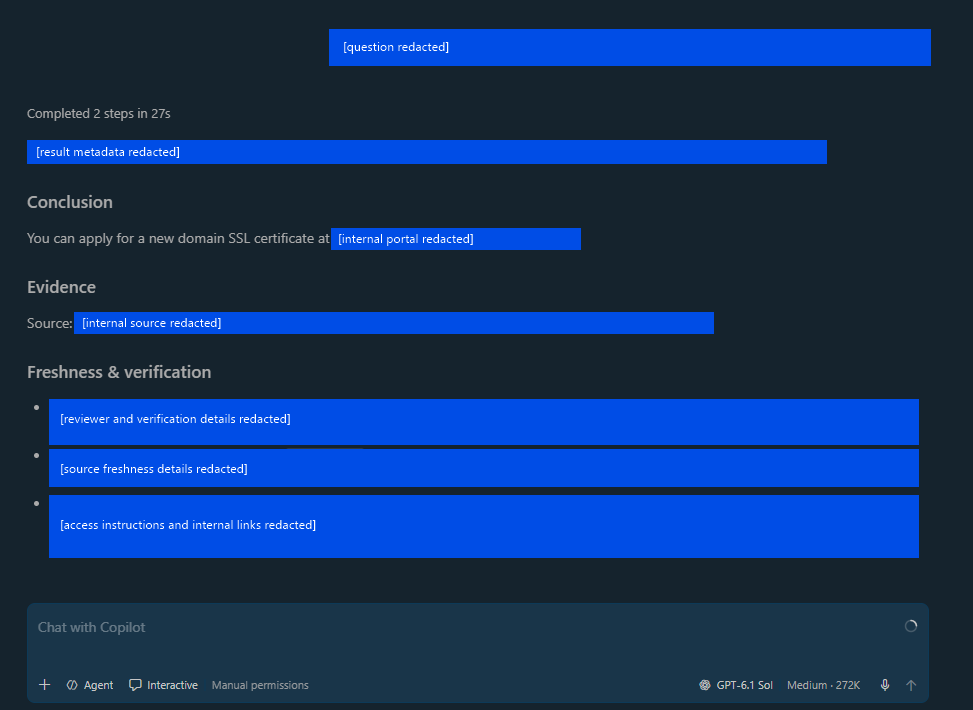
This pattern works for operational questions, onboarding guidance, data definitions, and repository conventions. For example, a developer could ask, “Where is the approved procedure for renewing a certificate?” The agent should locate the relevant concept, summarize only what that source supports, link to it, and say when verification or freshness is unknown. That is a response pattern, not a claim that the example runbook has been tested.
The screenshot below shows the answer structure in a Copilot knowledge search. Internal source names, reviewer details, access instructions, and the original question have been redacted; the visible conclusion and evidence layout are for illustration.
Summary
OKF provides a simple, versionable structure for knowledge that people and agents can both read. Its v0.3 additions make it easier for consumers to understand provenance, whether a verification still applies, freshness deadlines, and concept lifecycle.
Pairing an OKF bundle with GitHub MCP Server gives an agent a practical route to search and read repository knowledge. Keep the boundaries clear: OKF describes the knowledge, MCP exposes tools, and the agent retrieves and explains evidence. Start read-only, cite the source concepts, report unknown trust or freshness honestly, and keep private information out of public examples.